Are Silkie Chickens Good With Children? Why They're One of the Best Backyard Chickens for Families
Updated: Aug 15
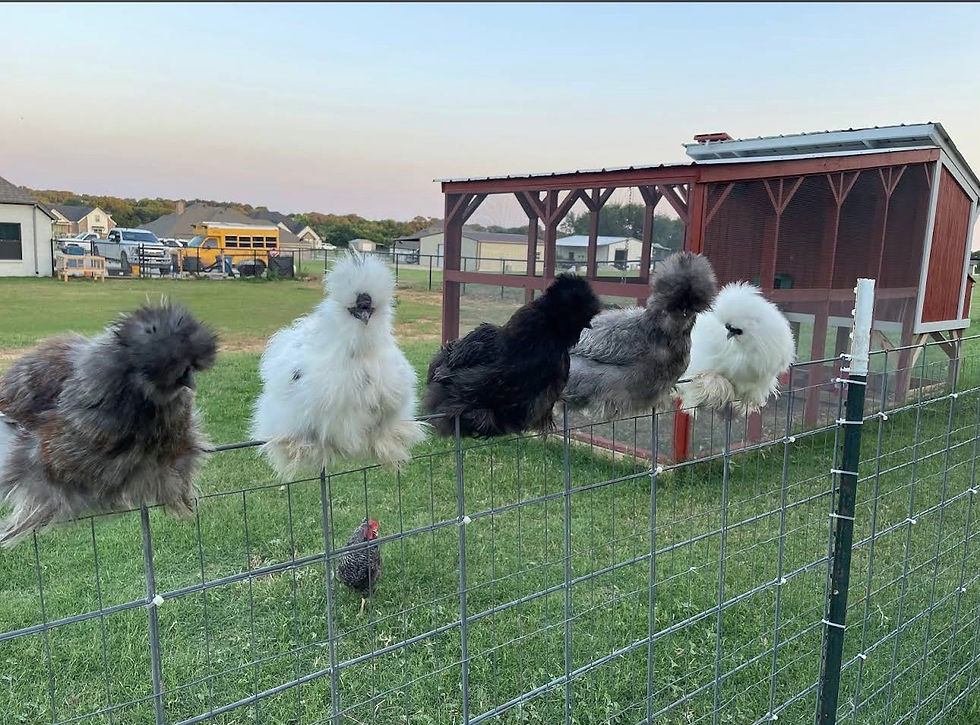
If you're thinking about getting chickens for your family, you've probably wondered: Are Silkie chickens good with children?
Make An Appointment Now! 817-550-1765
The short answer is yes—Silkie chickens can be an excellent choice for families with children, especially when the children are taught how to handle and care for chickens properly.
Silkies have a reputation for being unusually friendly, calm and easy to handle. They're also one of the most unique-looking chicken breeds you'll ever see. Their fluffy, almost furry-looking feathers, rounded crests and gentle personalities make them especially popular with families who want chickens that become backyard pets rather than simply egg-producing machines.
But if you live in North Texas, there are a few additional things you need to consider.
Here in Weatherford, Parker County and throughout North Texas, our chickens have to deal with some seriously hot summers. Silkies can do well here, but they need proper shade, ventilation, fresh water and a little extra attention when temperatures climb.
If you're considering Silkie chickens for kids in Texas, here's what you should know before bringing them home.
Why Are Silkie Chickens So Good With Children?
One of the biggest reasons Silkies are popular with families is their temperament.
Silkies are generally known for being docile and easy to handle. They aren't the kind of chicken that typically wants to run away screaming every time somebody walks toward the coop.
Of course, every chicken has its own personality. You can get a sweet chicken from almost any breed, and you can occasionally get a chicken with an attitude from almost any breed.
But Silkies have earned their reputation as one of the more gentle and personable chicken breeds.
That's particularly important when you're introducing chickens to children.
A child can learn to:
Gently pick up a chicken
Hold it securely
Feed it treats
Fill its water container
Collect eggs
Help clean the coop
Watch chicken behavior
Learn about responsibility and animal care
And let's be honest—children tend to become pretty attached to Silkies.
They're hard not to love.
There's something about walking into the backyard and seeing a fluffy little chicken wandering around that makes people smile.
Make An Appointment Now! 817-550-1765
Silkies Are More Like Pets Than Some Other Chicken Breeds
If your primary objective is producing as many eggs as possible, a Silkie probably isn't going to be your first choice.
There are plenty of chicken breeds that will outperform Silkies in egg production.
But if you're looking for a backyard chicken that can become part of the family, Silkies are a different story.
They're ornamental chickens, companion chickens and backyard pets that happen to lay eggs.
That's one reason they're so popular with children.
Kids can give their chickens names. They can learn to recognize individual personalities. They can watch the flock develop its own pecking order.
And eventually, they may discover something every chicken owner eventually learns:
Chickens have personalities.
Some are bossy.
Some are shy.
Some are curious.
Some will follow you around the yard.
And some will stare at you like you're an idiot for having the audacity to walk into their territory.
Silkies can be especially entertaining because of their unusual appearance and personalities.
Teach Children How to Handle Silkies
Even though Silkies are generally gentle, children still need to learn how to handle chickens properly.
The most important rule is simple:
Be gentle.
A chicken isn't a stuffed animal.
Children should never grab a chicken by its feathers, wings, tail or feet.
Instead, teach them to approach the chicken calmly and place both hands around its body. Supporting the chicken's body and feet helps it feel secure.
Very young children should always be supervised when handling chickens.
It's also important to teach children to respect the chicken when it wants to be left alone.
If a chicken walks away, let it walk away.
If it's eating, nesting or behaving agitatedly, give it some space.
That's actually a great lesson for kids: animals have boundaries, too.
Make An Appointment Now! 817-550-1765

One Big Advantage: Silkies Don't Fly Well
Here's another thing that makes Silkies interesting for backyard families.
Silkies aren't particularly good flyers.
Their unusual feather structure doesn't function like the smooth, stiff feathers found on many other chicken breeds. As a result, Silkies generally don't have the same flying ability as many standard chicken breeds.
That can make keeping them in a backyard setup easier.
But it also means you should design their coop with their limitations in mind.
Give Your Silkie Chickens a Low Roosting Perch
One of my recommendations for Silkies is to provide a low roosting perch.
Don't build a roost six feet off the ground and expect a Silkie to fly up there like a regular chicken.
They aren't built for that.
A low perch gives them an opportunity to roost without requiring them to make a major jump or attempt a flight they're simply not equipped to perform.
Keep the perch low enough that a Silkie can easily get onto and off of it.
You can also provide a ramp if necessary.
The goal is to make the coop work with the Silkie rather than expecting the Silkie to adapt to a conventional chicken setup.
Silkie Chickens and North Texas Heat
Now let's talk about the elephant—or perhaps the chicken—in the room.
Texas gets hot.
And if you're raising chickens in Weatherford, Aledo, Brock, Springtown, Azle, Willow Park or anywhere else around North Texas, summer heat needs to be taken seriously.
Silkies can live in Texas, but you shouldn't simply put them in a small coop with a metal roof and assume they'll be fine.
Their unique feathering can make heat management more challenging.
The most important things you can provide are:
Plenty of shade
Good ventilation
Fresh drinking water
Air movement
Protection from direct afternoon sun
A dry, comfortable place to rest
And during a North Texas summer, shade cloth can be one of your best friends.
Use Shade Cloth for Your Silkie Run

Make An Appointment Now! 817-550-1765
If your chicken run doesn't have enough natural shade, consider installing shade cloth over part or all of the run.
You don't necessarily have to build an expensive structure.
A properly installed shade cloth can provide significant relief from the direct Texas sun.
This is especially important during the hottest part of the afternoon.
One thing I like about shade cloth is that you can use it to create a dedicated shaded area while still allowing airflow.
That's important.
You don't want to solve a sun problem by creating a hot, enclosed box.
You want shade plus ventilation.
If you have trees available, natural shade is excellent. But don't assume that the shade will remain in the same place throughout the day.
Watch your chicken run during the afternoon and see where the shade actually falls.
You may discover that the spot that's shaded at 10 a.m. is sitting in direct sunlight at 3 p.m.
That's Texas.
Fresh Water Is Critical During a Texas Summer
Your Silkies should always have access to clean, fresh drinking water.
During the summer, check their water more frequently than you might during cooler weather.
A water container sitting outside in the Texas sun can become surprisingly warm.
I also recommend having more than one water source if you have a larger flock.
That way, if one gets tipped over, contaminated or emptied, the chickens still have access to water.
And if you're going out of town, make sure someone is checking the flock.
A chicken can survive a surprisingly long list of things.
Being without water during extreme heat is not one of them.
Ventilation Is Just as Important as Shade

A common mistake new chicken owners make is thinking that a chicken coop needs to be completely enclosed.
It doesn't.
Chickens need protection from predators and weather, but they also need good airflow.
Hot, stagnant air inside a coop isn't good for your birds.
Make sure your coop has adequate ventilation, particularly near the upper portions of the structure where hot air can escape.
At the same time, avoid creating strong drafts directly across the birds' sleeping area.
The goal is airflow—not a wind tunnel.

What About Children and Chicken Chores?
One of my favorite things about keeping backyard chickens is that they can teach children responsibility.
You don't have to hand your six-year-old a shovel and tell them to clean the entire coop.
Start small.
Depending on the child's age, they can help with:
Water:Check that the chickens have clean water.
Feed:Help measure and fill the feeder.
Eggs:Collect eggs carefully.
Observation:Learn to recognize when a chicken isn't acting normally.
Treats:Give appropriate treats in moderation.
Cleaning:Older children can help with simple coop-cleaning tasks under supervision.
The important part is making chicken care a routine.
Animals don't care whether it's Saturday morning or whether your child would rather be playing video games.
They still need to be fed.
That's a pretty good lesson in responsibility.
Make An Appointment Now! 817-550-1765
Where to Buy Chicken Feed in Weatherford
If you're raising chickens in Weatherford, one of the local places worth knowing is Dillard Feed & Seed Store on Main Street.
Dillard Feed & Seed Inc
They're located at 319 N. Main Street in Weatherford and have been serving the area since 1970. They carry poultry feed along with feed and supplies for a variety of other animals.
One of the things I like about buying feed there is the old-fashioned customer service.
You don't have to wrestle a 50-pound bag of feed into your vehicle yourself. The guys in the back will typically load the bags into your vehicle for you. Local customers also frequently mention the quick loading service.
And here's another thing I've noticed:
You can often get what feels like 50 pounds of feed for what you'd pay for 40 pounds elsewhere.
Obviously, feed prices change, so check the current price before making a buying decision. But if you're raising chickens in Parker County, it's worth checking out a local feed store rather than automatically assuming the big-box stores are your best deal.
Dillard's also advertises delivery within Parker County, which can be especially convenient if you're buying multiple bags at once.
That's one of those local Weatherford resources that new chicken owners should know about.
Are Silkies Good for a First-Time Chicken Owner?
They can be.
But I wouldn't recommend buying Silkies simply because they're cute.
And let's face it—they're really cute.
Before buying any chickens, you need to be prepared for the responsibility that comes with keeping them.
That means having:
A secure coop
Predator protection
Adequate space
Clean water
Appropriate feed
Shade
Ventilation
A plan for extreme weather
A way to separate sick or injured birds
Time for daily care
If you have those things in place, Silkies can be a wonderful introduction to backyard chickens.
Make An Appointment Now! 817-550-1765

What Predators Should North Texas Families Watch For?
This is particularly important if you're raising chickens around Weatherford and Parker County.
Predators don't care how cute your chickens are.
Depending on where you live, you may need to protect your flock from raccoons, opossums, snakes, hawks, coyotes, dogs and other predators.
Silkies' poor flying ability makes predator protection even more important.
Don't assume a chicken can simply fly up into a tree to escape danger.
A secure run with appropriate hardware cloth and a covered top can provide much better protection.
And remember that children should never be responsible for opening or securing the chicken coop without adult supervision.
Are Silkie Chickens Good Around Other Chickens?
Generally, Silkies can live with other chickens, but you need to pay attention to flock dynamics.
Because Silkies tend to be smaller and have limited flying ability, they can sometimes be at a disadvantage around larger or more aggressive breeds.
If you're putting Silkies into an existing flock, don't simply toss them into the coop and walk away.
Introduce new birds carefully.
Give them time to see and interact with the existing flock while separated by a barrier before allowing them to fully mix.
And keep an eye on the birds afterward.
A little pecking-order behavior is normal.
Constant harassment isn't.
Silkies Are Great Chickens for Kids—But They're Still Chickens
This is probably the most important point in the entire article.
Silkies can be wonderful chickens for children, but children need to understand that chickens aren't toys.
They are living animals.
Your child should learn to approach them quietly, handle them gently and respect their space.
With proper supervision, backyard chickens can give kids an opportunity to learn about animal behavior, responsibility, food production and basic husbandry.
And there are few things more rewarding than watching a child walk into the backyard, collect an egg from a nest box and proudly bring it into the house.
So, Are Silkie Chickens Good With Children?
Yes.
If you're looking for a friendly, unusual and entertaining backyard chicken, Silkies are definitely worth considering.
Their generally gentle temperament makes them appealing for families. Their unusual appearance makes them fascinating to children. And their personalities can make them much more like backyard pets than livestock.
For families in Weatherford, Parker County and North Texas, you'll just want to take the Texas climate seriously.
Give your Silkies plenty of shade.
Consider using shade cloth during the hot summer months.
Make sure they have plenty of fresh water.
Provide good ventilation.
Protect them from predators.
And because Silkies don't fly particularly well, consider installing a low roosting perch rather than expecting them to jump onto a high roost.
Do those things, and you can give your family and your chickens a much better environment.
And if your kids become completely obsessed with Silkies after getting their first one?
Don't say I didn't warn you.
These fluffy little chickens have a way of taking over the backyard—and eventually, probably the family.
Looking for Silkie Chickens in North Texas?
Make An Appointment Now! 817-550-1765

If you're located in Weatherford, Parker County or the surrounding North Texas area and you're looking for Silkie chickens, chicks or other backyard poultry, check out The Chicken Man TX.
We raise chickens right here in North Texas and understand the unique challenges of keeping poultry in our Texas climate.
Whether you're a first-time chicken owner or you've had chickens for years, we're happy to help you find birds that are a good fit for your backyard flock.
The right chicken can become more than an egg layer.
It can become part of the family.
How Many Eggs Do Silkie Chickens Lay?
Silkie chickens aren't known for being powerhouse egg layers, but they produce a respectable number of eggs for a small, ornamental breed. A healthy Silkie hen will typically lay about 3 to 4 eggs per week, although production can vary depending on age, season, nutrition, daylight and the individual hen. Some hens will lay more, while others may take regular breaks—especially when they're broody.
Silkie eggs are usually small to medium-small in size compared with the eggs you would get from breeds such as Rhode Island Reds or White Leghorns. Their shells are generally cream to light-tinted in color, sometimes with a slightly off-white or subtle beige appearance.
And here's something every Silkie owner eventually discovers: those little eggs are really tasty.
There's nothing quite like collecting a fresh Silkie egg from the nest and bringing it into the kitchen. The eggs may be smaller than the jumbo eggs you see at the grocery store, but they're excellent for cooking, breakfast and baking. If your kids are involved in collecting the eggs, it also gives them a great opportunity to see exactly where their food comes from.
So while you probably shouldn't buy Silkies if your primary goal is maximum egg production, they can provide a nice supply of delicious backyard eggs while also giving your family an entertaining and unusually friendly chicken to enjoy.


Comments